







|
|
Colin Ware
Faculty of Computer Science
University of New Brunswick
Box 4400, Frederiction, New Brunswick, Canada, E3B 5A3
cware@UNB.ca
A class of visual metaphors is introduced in which simple animation
conveys meaning about motion metaphorically. Antecedents in the
form of static metaphors for visually conveying motion are discussed,
followed by two examples of moving motion metaphors. The second
is an integral part of a new heads-up flying interface for navigating
3D environments. Some concluding remarks are made concerning the
practical uses of moving motion metaphors.
Metaphors, 3D Interaction
Most user interface metaphors are static in their presentation
and in the way that they convey metaphoric meaning, although there
are a few that are animated, such as the busy indicator showing
that a process is active. In this paper I present a kind of animated
metaphor wherein the motion itself conveys meaning in a metaphoric
way. An important element in calling something a motion metaphor
is that the motion itself should adequately convey meaning. Thus
an animated running figure might be used to represent processor
activity, but the animation might not be the important component;
the static form might work as effectively.
The inspiration for these metaphors comes from prior work by Kennedy
and his co-workers, who described a number of ways in which static
drawings can convey information about motion [3,4]. These are
commonly used in cartoons. Figure 1 illustrates three examples.
Figure 1: Static lines used to metaphorically represent motion:
a) wake lines, b) strobe lines, c) and d) stream lines.
Kennedy argues that the use of these lines is metaphoric because
although wake lines are visible as a duck moves through water,
they are not visible as an object moves through air. Of the three
types of examples shown above, the strobe lines are the most questionable
as metaphor, because they do not occur in nature. However, they
may work either because we are familiar with strobe photography,
or because the retina retains partial images.
A need to provide good visual feedback about self motion in interactive
3D envionments provided the motivation for the two of moving motion
metaphors described here. The first solution was to show streamlines
from a predictive navigation aid. This is previously described
in detail in [2] but not in terms of the metaphor. Figure 2 shows
the predictor with its streamline tails. These tails are computed
by saving the sequence of positions as the predictor passes through
the three dimensional space. They evoke the smoke streams from
an aircraft or sky diver. The lines get longer with speed and
curve to reveal the rate of turn.
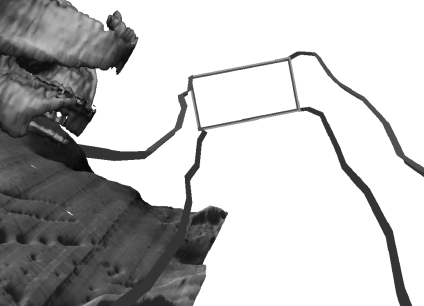
Figure 2. The rectangular box is a predictive flying aid. The
tails of the predictor indicate velocity.
The second solution is part of a new heads-up flying interface,
also designed for data exploration. This is illustrated in Figure
3. The interface consists of a set of velocity control widgets
located in the plane of the screen. The see-through design of
this interface was partly inspired by Bier et al [1], and partly
by the heads-up diplays used in fighter aircraft. In the center
is a rotation widget, flanking it are two identical translation
widgets used for translation at right angles to the line of flight,
and below is a forward/backward velocity widget. To increase or
decrease velocity on any of these widgets, the mouse button is
depressed over the widget, and a dragging motion is made in the
appropriate direction. For example, with the forward/backward
widget dragging upward results in increased forward motion and
dragging downward decreases the forward motion which eventually
results in backward motion. Note that Figure 3d gives an exaggerated
impression of the size of the widgets because it only shows a
portion of the screen. Motion feedback is provided in the form
of a metaphoric device adapted from Figure 1b. A series of dark
and light bars are animated away from the arrowhead and as they
move away they change from the black of the arrowhead to white.
This motion might be thought to be paradoxical in so far as the
actual animated motion is in the opposite direction to the direction
indicated. However, the visual metaphor is an analogy with puffs
of smoke being emitted from a moving train; the puffs of smoke
move backward relative to the train, indicating its forward motion.
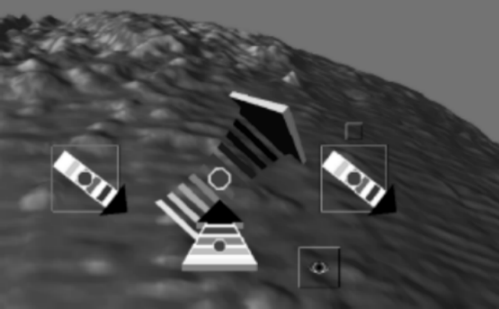
Figure 3. A heads-up flying interface with animated velocity feedback
on each of the widgets.
It is worth pointing out that in the case of rotation, the animated
motion is directly related to the rate of turn. However, in the
case of translational motion, the rate of motion is the square
root of the actual motion, so as to accomodate a wider range of
velocities without temporal aliasing effects becoming a problem.
When flying, any subset of these widgets can be activated. Each
provides continuous visual feedback via the motion metaphor. Each
widget also has a stop button, which instantly stops motion in
that direction or about that particular axis. The animated motion
metaphors appear to work well in providing direct visual feedback
concerning rate and type of motion. It is difficult to imagine
a static motion indicator that would be as effective or as easily
understood.
This paper presents a new class of visual metaphors, termed moving
motion metaphors, because they use animation to convey meaning
about motion, in a metaphoric manner. These types of metaphors
will become increasingly useful as interfaces become more animated.
Other kinds of animated metaphors are certainly possible. One
that is already common is a small turning disc that represents
processor activity on computationally intensive tasks. An interesting
idea would be to have icons jiggle up and down representing things
that require attention, metaphorically expressing agitation.
An intriguing possibility for the future development of powerful moving metaphors is that they may convey causality more powerfully than any static representation. The work of Michotte [5] showed that simple motions involving one patch of light moving and apparently "hitting" another, can powerfully express a causal relationship. Thus, moving metaphors expressing actions such as pushing, pulling, and striking could be used to represent causal interdependencies between on-
screen objects.