







|
|
In the 1980s, personal computers and networking transformed workplace communication [11]. As these social changes took place, few researchers and developers looked at networking in the home. And when they did look, they did so narrowly--seeing networking at home as an extension of networking in the office.
In the 1990s, computers are moving into the home at an enormous rate. In contrast to the 1980s, telecommuting and other workplace applications are not the only, or even the main, reasons for this change. By 1994, approximately 31% of US households had a computer [12], and in 1994, computers for the home represented 40% of PC sales. The potential for families, businesses, and community services is enormous. Yet we still lack an understanding of the changes taking place. In particular, we know very little about which electronic services are valuable to people across incomes in diverse communities. We also know little about how to make electronic services more valuable--whether through better design, better training, or a different array of services.
HomeNet is an empirical field trial of residential Internet use whose goal is to increase our knowledge about the use and impact of residential electronic services. It is a true, pretest-posttest field experiment. It uses a longitudinal panel design to study families over time. The project soon begins its second year. Our goal in this early report is to describe how average citizens (as represented in our study) use the Internet and to predict what leads them to use it.
To accomplish this goal, the HomeNet project is based on a service model with low barriers to entry. We loaned families a computer, or if they preferred, sold it to them at half price. Each family also received a high speed modem, and an extra telephone line as well as full Internet accounts for each family member above age 8 who wanted one. We simplified Internet access. All computers included a turnkey system--for access to the entire Internet--to newsgroups, the World Wide Web, electronic mail, MUDs, and special HomeNet chat newsgroups. Our software configuration allowed family members to use Internet services without learning the details of any computer operating system. Their Internet services were individualized, for example, by providing each family with a Web homepage pointing to information sources tailored to their identified interests. They received approximately three hours of training. We also offered on-line support through a help newsgroup and email, and an evening telephone help desk staffed by college students.
We recruited an initial sample of 48 families (157 individuals) through the public high schools of four neighborhoods in Pittsburgh, PA, selected for their demographic diversity. In each school, we recruited students who worked on the school newspaper and their families, as well as at least one journalism teacher and teacher's family. The common bond of journalism gave students from different schools something to discuss as we put the project on-line.
The result of these procedures is that while the HomeNet sample is not representative of the US population, it is more demographically diverse than existing Internet demographics (see Table 1).
N               157
Race            24% minority
Gender          57% female
Generation      42% <18 years old
Family income   25% <$35,000
Table 1: HomeNet sample demographics
Getting started was a major problem for many of the families. Connecting to the Internet is far more difficult than getting telephone or TV service. It requires that people correctly navigate a complex sequence of steps, from obtaining and setting up a computer, to establishing telephone service, to learning application software, to defining and remembering a password. Even with help and our simplified procedure, HomeNet participants had trouble connecting to the Internet for a wide variety of reasons--bad telephone lines and busy signals, passwords forgotten, depressed shift-lock keys on keyboards, erased login scripts, buggy software, and so forth.
Many participants lacked the skills to diagnose problems, in part because they did not have clear models of how components of the overall system operated. Their problems were more likely to be solved quickly if other family members or friends were more sophisticated than they or if they felt comfortable revealing their ignorance to the strangers on a help desk. Although teens typically became the most skilled computer users in their families, they were sometimes reluctant to share their expertise with their parents. Some participants blamed themselves for problems that were due to software bugs or overtaxed servers. Others asked for help from the project staff--122 times over the first 6 weeks of the trial period. The frequency of requesting help declined as people got started (or gave up), and as participants became more skilled in navigating the Internet.
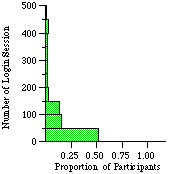
Figure 1. Distribution of logging into the Internet.
Of the 157 participants who received Internet accounts, 126 logged into the
Internet (i.e., dialed in to the HomeNet server) from home at least once during
the first 22 weeks of the trial. Participation differed enormously among them.
Figure 1 shows the distribution of Internet sessions per person. While the
modal number of logins was less than twice a week, some participants logged in
multiple times per day and had accumulated almost 500 logins during the first
22 weeks of the trial. The first three columns in Table 2 show some descriptive
statistics about participants'

Figure 2. Percent of Participants Logging in Per Week
Note: Percentages have been normalized to a equal number of participants
in each demographic group. If everyone in each group used the Internet weekly,
then the graph would show four parallel bands, each representing 25% of the
users.
use of different Internet services. The distribution of each of these measures is also highly skewed. For example, approximately 12% of those who logged in sent no electronic mail messages over the study period, but one user sent over 2500 messages.
Internet use was initially strong, but declined over time. During the first weeks of the trial approximately three-quarters of the participants logged in at least weekly (see Figure 2). Usage declined to about fifty percent by week 22. A noticeable dip occurred in week 14, when school let out for the summer, as travel, summer jobs, and outdoor activities cut into time on the computer.
Usage differed by generation and gender. For example, at the midpoint of the trial (week 11), 62% of the teenagers logged into the Internet compared to only about 45% of the adults. Among the teenagers, males were much heavier users than females; among adults, males were slightly higher user than females.
We find that these conceptually distinct services are complementary. People who used communication services were also likely to use information services, and vice versa, and both kinds of use predicted the number of logins to the Internet and the number of hours spent engaged with it. Table 2 shows the descriptive statistics for various measures of Internet use and the correlations among them. Because usage was skewed, measures were converted to the log scale before the correlations were calculated. The average correlation is high (.70 for all participants shown in Table 1 and .52 for the 88 heaviest users). This result indicates that HomeNet participants who used any Internet service used most of them--electronic mail, newsgroups, and the World Wide Web. Follow-up time-series analyses will allow us to determine whether communication or information consumption is causally prior.
Overall, the median teenager sent almost six times as many electronic mail
messages as the median adult. The generation difference, however, was greater
for males than for females. Teenage males sent 25 times more messages than
adult males, while teenage girls sent only six times more messages than adult
males. Teenage boys sent almost twice as many messages as teenage girls. Almost
all of the teenagers' messages went to other teens (94%), whereas the adults
communicated approximately equally to teens and other adults.

Table 2: Descriptive statistics about measures of Internet use and correlations among
them
Note. Descriptive statistics are in raw units. Measures were converted to a log scale for correlations.
Several of the teens discovered communication services that allowed them to exchange messages with friends and strangers in real time (Internet Relay Chat and various MUDs). One girl who had never dated started dating a boy she met over a chat service. Because of what seemed to be almost addictive behavior among some of the teenagers who used the real-time communication services, several parents imposed limits on their children's computer use.
When asked about their children's access to pornography on the net, parents told us they trusted their children to avoid inappropriate content. Some said the sexually-oriented materials that they personally checked out were no worse that the materials easily available to their children in the corner drug store. It is unclear, however, how general are these attitudes, given our sample of urban parents.
The information services that appealed to one or two people were extremely varied. Newgroups ranged from those associated with hobbies (e.g., needlepoint) to religion (e.g., Jewish culture) to professions (e.g., tax preparation).
Communication networks have long been known as vehicles for people to express themselves, for example, by assuming different personas in newsgroups [4]. Among our sample, group communication was easier technically than personalization of the computer (although we found in our home visits that some participants had trouble locating desirable newsgroups and Web sites). Both adults and teens engaged in group communication, and many became consistent members of virtual groups. Teens who became relatively sophisticated computer users gave advice in the HomeNet help group to strangers in the trial who were having trouble. Several adults shared their professional expertise on newsgroups: an accountant his tax knowledge and a doctor his knowledge of arthritis. Others offered advice on their hobbies: one woman gave advice on raising exotic pets.
These variables were grouped into four categories for purposes of analysis (Table 3). The category boundaries are arbitrary, but generally conform to the way home computing has been discussed in the literature, that is, as influenced primarily by economic and demographic factors, psychological or personality dispositions, computer skill and experience, and interest in various information sources (e.g., [12],[14]).
Below, we discuss each category of variables and the effects of each category singly. Then we construct an overall model, using all the significant variables from the previous analyses. This is an exploratory analysis, and does not use strong theory to test a deductive model. Also, it is a preliminary analysis examining only main effects on aggregate use. In later stages of this research we will investigate interactions, effects over time and differential predictions for communication and information services.
 Table
3. Predicting Internet Use.
Table
3. Predicting Internet Use.Note. - Table entries are Beta coefficients for predicting Internet use. Except for the binary variable of race, gender, and generation, the independent variables have been standardized with a mean of 0 and a standard deviation of 1. P-values are in parentheses.
coded as 1 if a participant's age was 21 or greater and 0 otherwise.
The second column of Table 3 shows how the demographic variables were related to Internet usage in our sample. Neither income nor education predicted usage. This finding suggests strongly that once economic barriers are removed, people across socioeconomic lines will use the Internet. By contrast, race, gender, and, especially, generation were strong predictors of Internet usage in our sample: whites, males, and teens were more likely to use the Internet than minorities, females, and adults, respectively. These effects all speak to strong cultural or social forces on Internet usage. Of all the variables, the difference between children and adults was the strongest predictor in the category, and turned out to be the strongest predictor across all analyses.
The results of this analysis, shown in the third column of Table 3, are that innovative and sociable people used the Internet more, and those who listed many hassles used the Internet less. People under time pressure did not use the Internet less than people with more free time. (This result is the same when we used time diary data on hours spent at work or school.) Also, depressed people used the Internet more than those who were not depressed. Innovativeness and sociability are correlated with healthy psychological status whereas depression is not. These results suggest that the Internet appeals to people at both ends of the continuum of psychological status, perhaps for different reasons.
People with more skill used the Internet more, but surprisingly, people with greater experience with a computer used the Internet less, holding constant their skill. (See the fourth column of Table 3.) Possibly the Internet appealed to veteran computer users less than to novices because exploring computers was less of a novelty. Or, veterans' might have developed an instrumental view of computing, a view inconsistent with the communication, casual exchange of information, and fun that they saw in the Internet culture. The perceived usefulness of computers and applications was unrelated to participants' use of the Internet.
People who read books were more likely to use the Internet, whereas people who watched TV were less likely to use it. (See the fifth column in Table 3.) The text-based nature of most services on the Internet may appeal most to people who read for information and entertainment.
Entering the demographic variables into the model reduces the effects of all the psychological dispositions, although participants' innovativeness reliably predicts their Internet use. Among the computer variables, those with more computer skill used the Internet more, whereas those with more computer experience used it less. Finally, people who watch TV were less likely to use the Internet.
Though studies show that high-income, educated white males dominate the Internet, the HomeNet study shows that once financial barriers are lowered, lower income and less well educated people are as likely to become enthusiasts. Race and gender, however, remain associated with Internet usage, perhaps because the Internet's mainly white, male users has created a resource environment most attractive to men and whites. (One HomeNet women complained that there was so much football and so little about fashions on the Web.) The bias in Internet resources might change if more women and minorities sign on.
HomeNet participants communicated heavily and used a wide range of information services. Only a few of the information services were broadly popular. People gravitate towards services that address their idiosyncratic interests. Since most individuals will be interested in only a few of the thousands of services offered them, they need easy ways to personalize their information space so that it reflects their interests as the interests and their resources change over time.
This report on the HomeNet project is preliminary. Later reports will include a larger sample, and will focus on family interactions, on dynamic processes, on use over time of different electronic services, and on the impact of Internet use on individuals, groups, and families. Additional documents about HomeNet are at: http://homenet.andrew.cmu.edu/Progress/.
2. Bendig, A. W., The Pittsburgh Scales of Social Extroversion, Introversion and Emotionality, The Journal of Psychology, 53: 199-209, 1962.
3. Cammann, Cortlandt, Mark Fishman, Douglas Jenkins, Jr. and John R. Klesh. Assessing the attitudes and perceptions of organizational members. Pp. 71-138 in Stanley E. Seashore, Edward Lawler, Philip H. Mirvis, and Cortlandt Cammann (Eds.), Assessing Organizational Change. New York: John Wiley & Sons, 1983.
4. Finholt, T., and L. Sproull, Electronic Groups at Work. Organization Science, 1, 41-64, 1989.
5. Igbaria, M. and W. M. Wormley, Race Differences in Job Performance and Career Success, Communications of the ACM,, 38(3):82-92, March 1995.
6. Kanner, A. D., J. C. Coyne, C. Schaefer and R. S. Lazarus, Comparisons of Two Modes of Stress Measurement: Daily Hassles and Uplifts versus Major Life Events, Journal of Behavioral Medicine, 4: 1-39, 1981.
7. Klawe, M. and N. Levenson, Women in Computing: Where are We Now? Communications of the ACM, 38(1):29-44, January 1995.
8. Leavitt, C. and J. R. Walton, Innovativeness: Openness of Information Processing, in (Eds.) W. O. Bearden, R. G. Netemeyer and M. F. Mobley, Handbook of Marketing Scales, Newbury Park, CA: Sage Publications, 1993.
9. Radloff, L., The CES-D Scale: A Self-Report Depression Scale for Research in the General Population, Applied Psychological Measurement, 1: 385-401, 1977.
10. Rockman, S., In School or Out: Technology, Equity and the Future of our Kids, Communications of the ACM, 38(6):25-29, June 1995.
11. Sproull, L. & S. Kiesler, Connections: New Ways of Working in the Networked Oganization. Cambridge, MA: MIT Press, 1991.
12. Times Mirror Center for the People and the Press. The Role of Technology in American Life. 1994
13. Venkatesh, A. and N. Vitalari, An Emerging Distributed Work Arrangement: An Investigation of Computer- Based Supplemental Work at Home, Management Science, 38(12):1687-1706, December 1992.
14. Vitalari, N. P., A. Venkatesh and K. Gronhaug, Computing in the Home: Shifts in the Time Allocation Patterns of Households, Communications of the ACM, 28(5):512-522, May 1985.