Towards Organizational Learning: Growing Group Memories in the Workplace
Stefanie N. Lindstaedt
Center for LifeLong Learning and Design (L3D)
Dept. of Computer Science
and
Institute of Cognitive Science
University of Colorado
Boulder, CO 80309-0430, USA
(+1) (303) 492-1218
stefanie@cs.colorado.edu
Abstract
Designing domain-oriented systems requires knowledge both in system design and in the domain to be supported.
Communication between domain experts and system developers is essential to elicit or activate this knowledge.
Contextualized information, conveyed in ongoing communication and evaluation, sheds light on problems and solutions that
may otherwise remain uncovered. This information is valuable beyond the particular situation in which it originates.
Experiences of our L3D research group with industries and universities have shown that the tasks of activating and capturing
communication about system design, relating it to prior experiences, and feeding new insights back into a group memory face
a number of challenges. I am developing an interactive group memory management system called GIMMe for growing diverse
group memories during software design to explore the issues surrounding these challenges.
Keywords
Design, system design, design rationale, group memory, organizational learning, collaborative work, CSCW, participatory
design
Introduction
Designing useful and usable domain-oriented systems is a highly demanding task. Such systems must account for the
interaction patterns specific to the application domain. The identification of those patterns and their ramification for a
computer system require knowledge and ongoing evaluation from both system designers and domain experts. Design activities
require collaboration among different stakeholders such as system developers, domain experts, and clients. This constraint is
due to a symmetry of ignorance, meaning that no individual stakeholder (or individual group of stakeholders) has all the
relevant knowledge. Much complexity in design arises from the need to: (1) synthesize different perspectives on a problem,
(2) manage large amounts of information potentially relevant to a design task, and (3) understand the design decisions that
have guided the long-term evolution of a designed artifact.
Henninger [4] has emphasized the importance of organizational learning [5] for software design: "An organizational learning
approach to software development uses an organization's accumulated knowledge of the development process and application
domains as the basis for design." Collecting all stakeholders' contributions in a group memory enables an organization to
acquire a body of knowledge that goes beyond each individual's limitations, in this sense organizational learning goes beyond
individual learning.
Problem
Many approaches seem to assume that organizational learning is a stand-alone activity, separate from daily design work.
Grudin [3], in his cost/benefit analysis, pointed out that approaches are doomed to fail when they make individuals work
merely for the sake of others, without perceived benefit to themselves. Our own experiences in large projects at NYNEX
Science & Technology (S&T), led us to the conclusion that an integrated approach, combining actual design work with the
collection and usage of relevant information while designing, can drastically increase the perceived benefit of recording
information in a group memory. Our work is based on the observation that argumentation in the form of design discussions
must serve the design process [2]. In my work I address the following basic challenge: If organizational learning, in the form
of previous design experiences, is to inform system design, two seemingly disparate goals must be served simultaneously: (1)
designers must be supported in getting current design work done, and (2) designers must be supported to record information
about the current design for future use.
Conceptual Framework
Our experiences with industries and universities have shown that in order to reach both goals simultaneously an organization
needs to address a number of challenges as shown in Figure 1. Group processes and artifacts can address each of these
challenges and link them in a self-reinforcing feedback loop. The feedback should occur in the short run, i.e., within one
project, to produce organizational learning in the long run. Failing to meet any one of these challenges can endanger the
success of the entire effort. Breaking the reinforcing feedback loop at any point will have an adverse impact on all the other
activities.
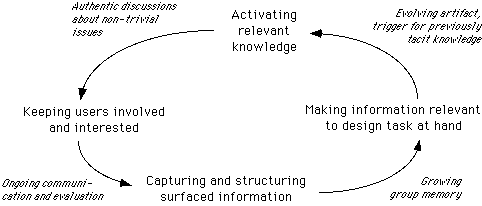
Figure 1: Challenges/activities and their interrelations in a feedback loop.
The situation calls for an integrated approach. I have developed a system prototype, the Group Interactive Memory Manager
(GIMMe), which addresses all of the challenges in the feedback loop to various degrees.
GIMMe
GIMMe is a web-based group memory system. It helps communities of practice (e.g., project teams, interest groups) to
capture, store, organize, share, and retrieve electronic mail conversations. Mail sent to a specific group alias is automatically
added to an information space and categorized according to its subject line. Group members can access the information space
via the internet. We implemented four retrieval mechanisms to this information space: (1) browsing in reverse chronological
order, (2) browsing according to project specific categories, (3) retrieval by free form text queries (using the Latent Semantic
Indexing algorithm [1]), and (4) information delivery of related mail messages. GIMMe supports users in creating,
rearranging, or deleting categories and the mail belonging to them. A more
detailed description of GIMMe can be found here. GIMMe is designed to allow groups to create and negotiate domain conventions over
time, as well as to evolve categories that reflect the structure and vocabulary of the application domain. The information
delivery mechanism provides the users with information relevant to the task at hand.
Related Work
My approach differs from other systems in several ways. Early design rationale systems (such as gIBIS) required designers to
perform a nontrivial amount of cognitive and manual overhead in order to collect and organize design rationale. For instance,
Terveen and Ackerman describe "expert systems" that are able to answer questions about technical issues specific to an
organization. These systems are targeted at supporting downstream system development processes such as implementation and
maintenance rather than the upstream design processes (i.e., requirements elicitation and evolution) supported by GIMMe.
Assessment in Practice
GIMMe is currently employed by project and research groups in NYNEX S&T and at CU Boulder. The different groups have
been using GIMMe for periods of time ranging from three weeks to four months. My experience with the different work
practices, patterns of electronic mail use, project types, and project stages has shown that GIMMe can be usefully employed
in very different settings and with varying commitment levels. This property of GIMMe ensures that groups that put more
effort into their group memory (e.g., by carefully designing categories) are rewarded with more immediate value with respect
to their project and at the same time contribute in a more valuable way to the organizational memory [3]. The use of GIMMe
has changed work practices by reducing overhead for the individual group members (e.g., mail has not to be stored locally,
mail can be send directly to interested subgroups while other members can view it in GIMMe if the need arises and repeated
discussions about the same topic can be cut short because the previous discussion was stored and is accessible). The direct
communication and the fast feedback cycle enabled group members to activate relevant tacit knowledge from all stakeholders
and to keep them involved and interested.
Future Work
The goal of my thesis is to make argumentation serve design by interrelating actual design tasks with GIMMe. I am
embedding GIMMe into a software development environment in order to better integrate up-stream and down-stream design
activities. In addition I will improve GIMMe using the insights gained to better meet the discussed challenges. Evaluations of
the improved system will give further insights and will help to refine the underlying conceptual framework.
Acknowledgements
I would like to thank Beatrix Zimmermann, the co-developer of GIMMe. She was of invaluable help during installation and
user interviews at NYNEX S&T. Special thanks also go to the L3D research group at CU and to Gerhard Fischer, my
advisor. This work is supported by NYNEX and NSF IRI-9311839.
References
-
Deerwester, S., Dumais, S.T., Furnas G.W., Landauer, T.K., and Harshman R.:
Indexing by Latent Semantic Analysis,
in Journal of the American Society for Information Science, 41(6), 1990,
pp. 391-407.
-
Fischer, G., Lemke, A.C., McCall, R., and Morch, A.:
Making Argumentation Serve Design,
Human Computer Interaction - Special Issue on Design Rationale, Vol. 6,
No. 3-4, 1991, pp. 393-419.
-
Grudin, J.:
Why CSCW Applications Fail:
Problems in the Design and Evaluation of Organizational Interfaces,
Proceedings of the Conference on Computer-Supported Cooperative Work
(CSCW'88), New York, 1988, pp. 85-93.
-
Henninger, S., Haynes, K., and Reith, M.:
A Framework for Developing Experience-Based Usability Guidelines,
Symposium on Designing Interactive Systems (DIS'95), Ann Arbor, Michigan,
1995, pp. 43-53.
-
Senge, P.M.:
The Fifth Discipline, The Art and Practice of the Learning Organization,
Currency Doubleday, New York, NY, 1990.