Providing Explicit Support for Social Constraints: In Search of the Social Computer
Ben Anderson
Dept. Computer Studies
Loughborough University of Technology
Loughborough
Leicestershire, UK
+44 (0)1509 222881
B.Anderson@lut.ac.uk
ABSTRACT
This short paper outlines an approach to the design and implementation of
systems that explicitly support the use of social, rather than technological,
methods of control. This approach draws on recent developments in the social
sciences, particularly sociology and anthropology, and builds upon current work
in the development of `Media Spaces' and other CSCW systems.
Keywords
CSCW, system design, social norms, videoconferencing
THE NATURE OF EVERYDAY WORK
As a number of recent authors in the fields of HCI and CSCW have noted,
interaction and collaboration take place in the context of richly varying
cultural and organisational norms and forms of behaviour ([2], [6], [10], [11]
). The exact nature of these norms is never static; social rules develop and
change as organisations change personnel and practices so that what is
considered acceptable behaviour is likely to evolve over time. In addition,
`acceptable behaviour' is subject to the rapid and fluid changes of situation
that are characteristic of everyday work practice, for example sifting through
an individual's desk to find a paper may be acceptable in the context of
working on a shared document, but may not be acceptable later that same day
when that brief phase of work is finished. What may be considered appropriate
behaviour by any particular individual is therefore the result of extremely
complex interactions between organisational, social and highly context-specific
factors.
Given such a conception, it is clear that computer systems designed to support
or mediate everyday interaction must be able to support its extremely fluid,
complex and context sensitive, i.e. `situated' [10] nature.
EMBEDDED CULTURAL MODELS
Current approaches to design tend to provide users with options
for behaviour, based on models of social practices, that are embedded within
the system itself. Thus Media Spaces are designed using models (or user-defined
rules) of who can do what, when and to whom (cf. [2] for a review); shared file
systems are designed so that access controls are fixed by models of who can
have access to which resources and with what privileges (e.g. [4]); and
collaborative systems, such as meeting tools and workflow systems, incorporate
models of floor control and of business processes (cf. [3]).
In all of these cases, the response to the complexity of social norms of
behaviour has been a trend towards the incorporation of ever more complex
models of these norms, or the provision of a number of different models from
which an individual or group can choose (e.g. [3]). However, recent studies of
both everyday work, interaction and also the social practices surrounding
collaborative technologies (e.g. [5], [11]) have suggested that the approach of
embedding complex models of behaviour in the system itself may be fundamentally
misconceived.
AN ALTERNATIVE VIEW
This paper adopts the view that the everyday world consists of 'cues for
behaviour' that allow us to choose the most appropriate from a range of
'options for action', any one of which is physically, although not socially,
possible. Our behaviour in the world is therefore fundamentally regulated by
physical constraints that govern what we can and cannot actually do,
together with highly dynamic cultural constraints that govern what we
usually do (and when), which we could, in principle, choose to ignore (cf.[9]).
When considering the design of systems to support social interaction, this view
implies that it may not be necessary (nor even desirable) to embody a set of
social rules in the physical system (if the system can provide sufficient
options for action and cues for behaviour) since to do so would be to turn
cultural into physical constraints. A social computer, then, is a
system which does not have social rules embedded within it, but which enables
users to apply their knowledge of social protocols in deciding what they
should do.
There is considerable evidence in the Media Space and Computer Supported
Collaborative Work (CSCW) literature to suggest that such an approach may be
effective. As Dourish notes for example, social protocols and norms of
behaviour contribute to accepted practices of use as much as any system imposed
constraints [2]. Similarly, users of the Internet's multicast backbone (MBONE)
tools [7] have participated in video, audio and `shared whiteboard' conferences
ranging in size from between 2 and around 60 participants. Even though none of
the MBONE tools provide explicit methods of turn-taking or floor control,
their usage has been highly successful based on a shared culture of use. A
survey of recent research on groupware (in particular collaborative writing) is
uncovering similar supportive evidence.
A PROOF OF CONCEPT PROTOTYPE
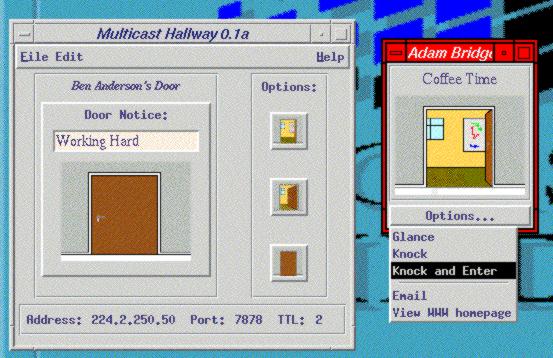
In order to assess the effectiveness of the ideas underlying the `Social
Computer', a proof of concept prototype is currently under construction. This
prototype provides an interface to a broadband telecommunications
infrastructure using the metaphor of an office door to represent the
availability state of the users (see Figure 1).
The principles of the `Social Computer'
suggest that the state of the office door should not be used to determine which
options are made available. Instead, all options should be available and it is
then up to the user to decide which option is appropriate in the particular
situation at that time [1]. Key issues then, are discovering what cues people
use in the everyday world to regulate their behaviour, what that behaviour is,
and whether both the cues and the behaviour are transferable to a
computer-mediated system. The implementation draws on [1] which has already
gone some way towards exploring the first two of these issues using elicitation
techniques from Cognitive Anthropology.
The prototype is implemented in Tcl/Tk [8] with extensions to enable interface
prototyping in a multicast UNIX environment. It makes extensive use of freely
available MBONE audio, video and whiteboard conferencing tools vic, vat and wb
[7], together with trials over local and possibly wide area multicast networks
in order to provide a functional, integrated, broadband telecommunications
prototype. Given the use of freely available Internet audio/video tools, and
the intended scalability of the prototype, these trials will be carried out on
a national, and possibly global, scale.
EVALUATION AND ANALYSIS
The work will conclude with an evaluation and analysis of the effectiveness of
the prototype with respect to the principles of the `Social Computer'. Standard
usability evaluation techniques will be used to assess the degree to which
users found the system effective in providing support for social constraints,
in preventing mis-use whether intentional or not, and in supporting the
flexible and dynamic nature of human interaction. In addition the analysis will
examine the scalability of the principles underlying the `Social Computer' to
situations where the users may not share a common culture and therefore where
social constraints may be ineffective.
ACKNOWLEDGEMENTS
This work is supported by a research scholarship funded by British
Telecommunications plc. The MBONE tools vat (Visual Audio Tool), vic (Video
Conferencing tool) and wb (WhiteBoard) were developed at Lawrence Berkeley
Labs, University of California *; Tcl/Tk was
developed at the University of California at Berkeley.
REFERENCES
1. Anderson, B. & Alty, J. L. (1995) "Everyday Theories, Cognitive
Anthropology and User-Centred System Design". In Proc. People and Computers
X, HCI `95. August 1995. Cambridge University Press.
2. Dourish, P. (1993) Culture and Control in a MediaSpace. In Proc. ECSCW
`93. Milano, Italy, September 1993. Kluwer, London. pp 125-137
3. Greenberg, S. (1991) "Personalizable groupware: Accommodating individual
roles and group differences." In Proc. ECSCW `91 Amsterdam, Kluwer
Press. pp 17-32.
4. Greif, I. & Sarin, S. (1987) "Data sharing in group work." ACM
Transactions on Office Information Systems Vol. 7 no 2 pp 187-211.
5. Heath, C. & Luff, P. (1991) "Disembodied Conduct: Communication through
video in a MultiMedia Office Environment". In Proc. CHI `91, New
Orleans, Louisiana, April-May 1991, pp. 99-103.
6. Kaplan, S. M., Tolone, W. J., Bogia, D. P. and Bignoli, C. (1992) "Flexible,
Active Support for Collaborative Work with ConversationBuilder" In Proc.
CSCW `92, November 1992, Toronto, Canada. ACM Press.
7. Macedonia, M. R., Brutzman, D. P., (1994) "MBone Provides Audio and Video
Across the Internet" IEEE Computer, Vol. 27 No 4, pp. 30-36.
8. Ousterhout, J. K. (1994) Tcl and the Tk toolkit. Addison Wesley, New
York.
9. Searle, J. R. (1994) The Social Construction of Reality. Free Press, New
York.
10. Suchman, L. A. (1983) Office procedures as practical action. ACM
Transactions on Office Information Systems 1: 320-328.
11. Suchman, L. A. (1987) Plans and Situated Actions. The problem of
human-machine communication. Cambridge University Press.
FOOTNOTES
For more information on the MBONE see http://www.best.com/~prince/techinfo/mbone.html.
Providing Explicit Support for Social Constraints: In Search of the Social Computer
B.Anderson@lut.ac.uk








 (51kb JPEG)
 (116kb JPEG)